
January 28 - May 3, 2026
Henri Cartier-Bresson was a convinced European.
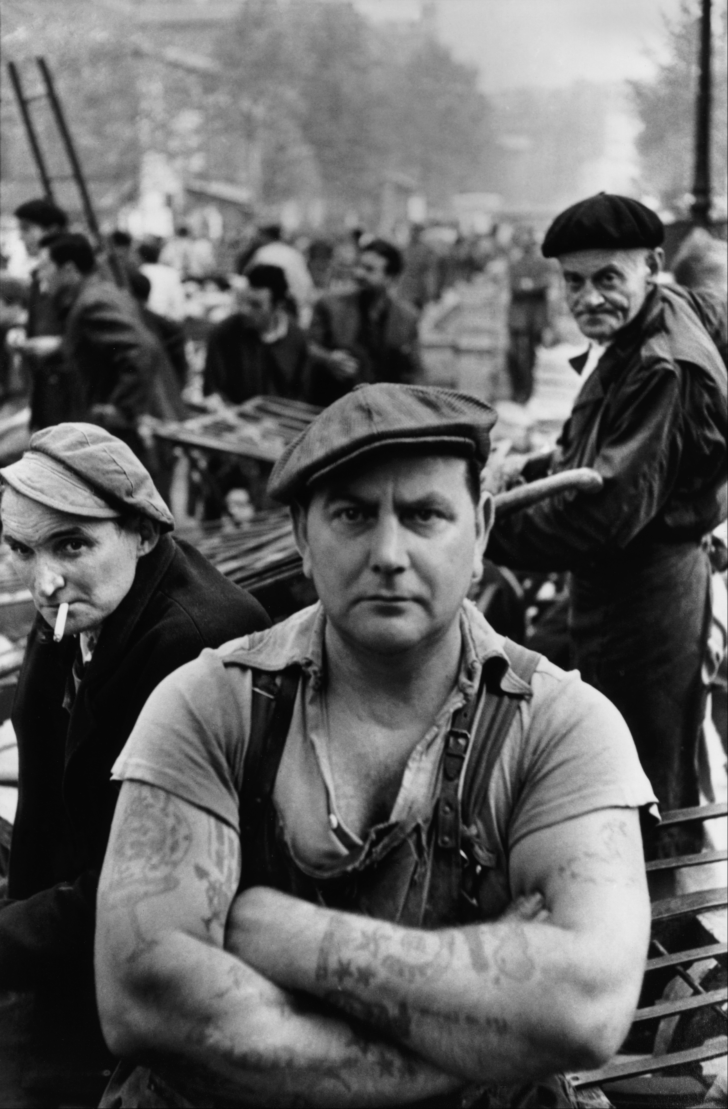
While he traveled all over the world, he also explored Europe extensively. After the Second World War, the continent was a vast field of ruins haunted by rupture and desolation. In the context of the Cold War, the construction of the European Union was one of the major geopolitical issues of the time. After producing numerous photographic series for magazine press in Germany, Spain, Italy, Greece, Switzerland, and France, Cartier-Bresson wanted to bring them together in a single volume. He did not intend to create a travel book about these countries, as many existed at the time, but rather a portrait of the people who inhabit them. The book was indeed not titled Europe, but The Europeans.
His aim was to show what makes each people of this geographical area unique, while highlighting their shared humanity. Featuring a stunning cover by the Catalan painter Joan Mir., the book was published in 1955 by Verve, as a follow-up to The Decisive Moment. It had never been republished since. The present exhibition brings together some of the most important photographs from the book on the occasion of its reissue.
Curator of the exhibition
Clément Chéroux
Director, Fondation Henri Cartier-Bresson
Henri Cartier-Bresson is regarded as one of the greatest photographers of the 20th century. After studying painting and associating with the Surrealists, he adopted photography as his means of expression in the early 1930s.
He witnessed and documented the major political and social upheavals of the 20th century: taken prisoner during World War II, he escaped and joined the Resistance. He photographed the final days of Gandhi in India, Communist China, the USSR during the Cold War, postwar United States, and the struggles for independence in Africa.
In 1947, he co-founded the Magnum Photos cooperative with Robert Capa, George Rodger, and David Seymour, an organization designed to give photographers control over the distribution of their images. That same year, the Museum of Modern Art in New York held a retrospective of his work.
From the 1970s onwards, after dedicating his career to photography and making several documentary films, he turned away from these mediums to focus on drawing.
In 2003, one year before his death, he co-founded the Fondation Henri Cartier-Bresson with his wife, the photographer Martine Franck, and their daughter Mélanie.